 Campfire Editorial Team
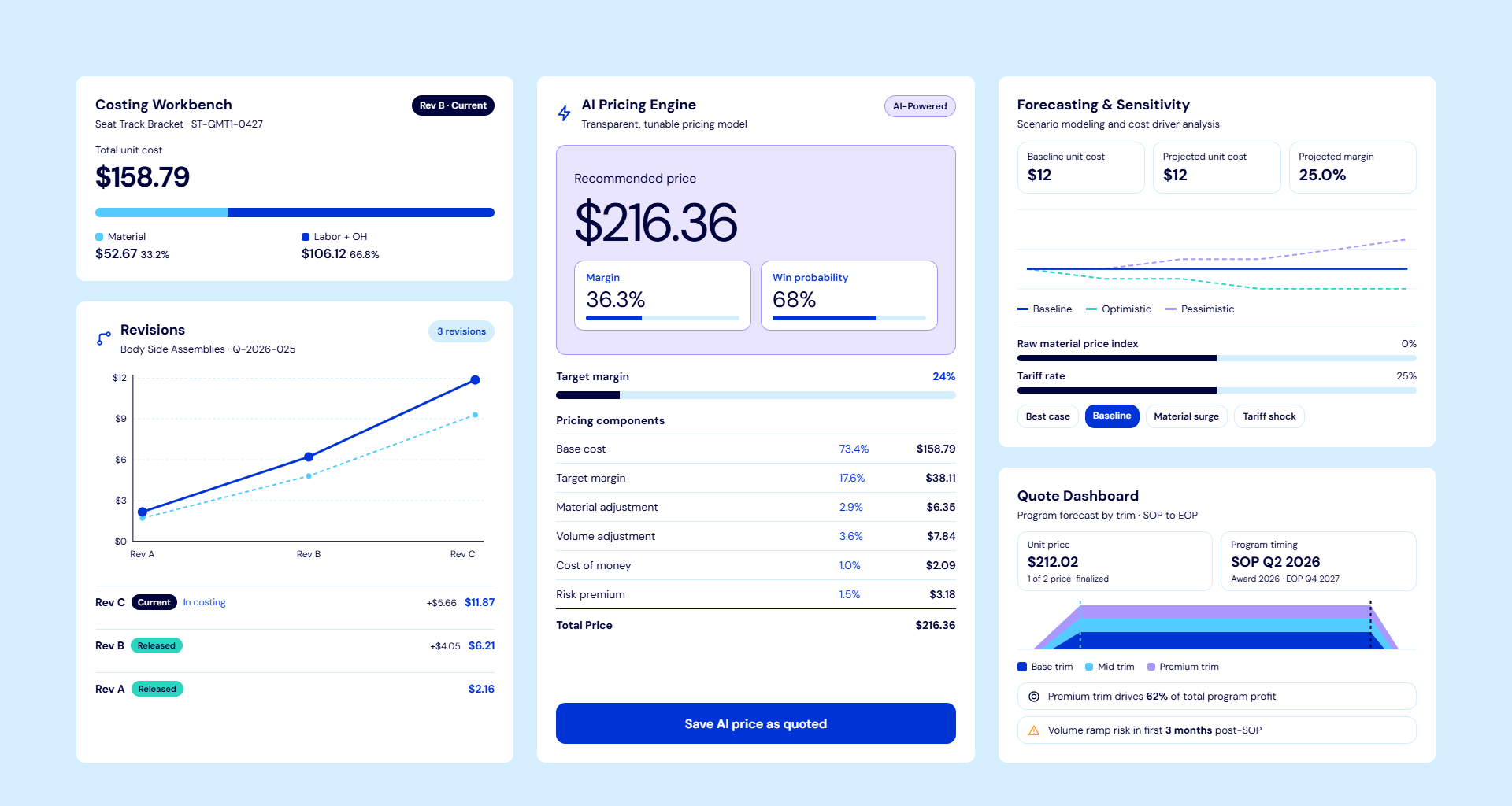
The best CPQ software for automotive suppliers keeps the full cost breakdown inside the quote, prices across the whole program life with step-downs built in, and records every revision, so a quote can still be defended years after it is sent. It is not judged by how fast it produces a number. It is judged by whether that number holds up when an OEM, an auditor, or your own finance team asks how it was built.
Key Takeaways
-
An automotive piece price is built from material, labor, overhead, freight, and tooling, spread across five or more years of volume with annual price-downs, so CPQ has to model a program, not a single transaction.
-
Most CPQ platforms store the output of a pricing decision, not the reasoning behind it, which pushes the real cost model into side spreadsheets.
-
Modeling a five-year program at a flat price instead of its actual 2% annual step-downs overstates revenue by about $1.2M on a 300,000-unit, $20 part.
-
The three things that separate automotive CPQ from a pricing calculator are a cost breakdown inside the quote, pricing that follows the shape of the program, and a record of every revision.
-
Margin is most often lost after award, and a quote with documented assumptions is what makes price recovery possible.
Why do most CPQ tools fall short for automotive suppliers?
Most CPQ tools fall short because they were built for a simpler transaction: a product, a discount, a final number. Automotive quotes are multi-year commitments built from many cost elements, and when a CPQ tool can only hold the final price, the reasoning behind it ends up somewhere else.
Picture this. Six months into production, an OEM comes back and asks how a piece price was calculated. For most suppliers, that question sets off a scramble through old emails, a buried spreadsheet, and calls to someone who no longer works there. The person who built the original model has usually moved to another plant, or retired to a lake, which is a fine choice for them and a bad one for your audit trail.
Franco D'Alimonte, Campfire's Vice President of Customer Experience, has seen this pattern play out across the supply base. When quotes are rushed through disconnected spreadsheets, he writes, "the gap between the priced margin and the realized margin shows up six months later when nobody can find the original assumptions."
That gap gets filled by a spreadsheet tracked outside the CPQ tool, and that spreadsheet becomes the real system of record. When a revision happens, there is no clean record of who changed what or why. When a customer asks how a number was built, the answer depends on who is still around to remember.
It is not that generic CPQ is bad software. It is very good at configuring products and applying discounts for industries where a price is set once. Automotive just asks for something different.
Generic CPQ vs. purpose-built automotive CPQ
| Generic CPQ | Built for automotive suppliers | |
|---|---|---|
| What a quote holds | A final price and a discount | Material, labor, overhead, freight, and tooling, each visible |
| Pricing shape | One price, set once | Multi-year pricing with volume-based step-downs |
| Revisions | A version number | A record of what changed, when, and against which cost assumptions |
| Material costs | Fixed at the time of quoting | Tied to current index data |
| Link to the RFQ | Retyped from the sales system | Program and volume details carried in from the opportunity |
| After award | The quote becomes a PDF | The full cost record carries forward to sales and program teams |
| When someone asks "how was this built?" | It depends who is still around | The answer is in the system |
What should automotive suppliers look for in CPQ software?
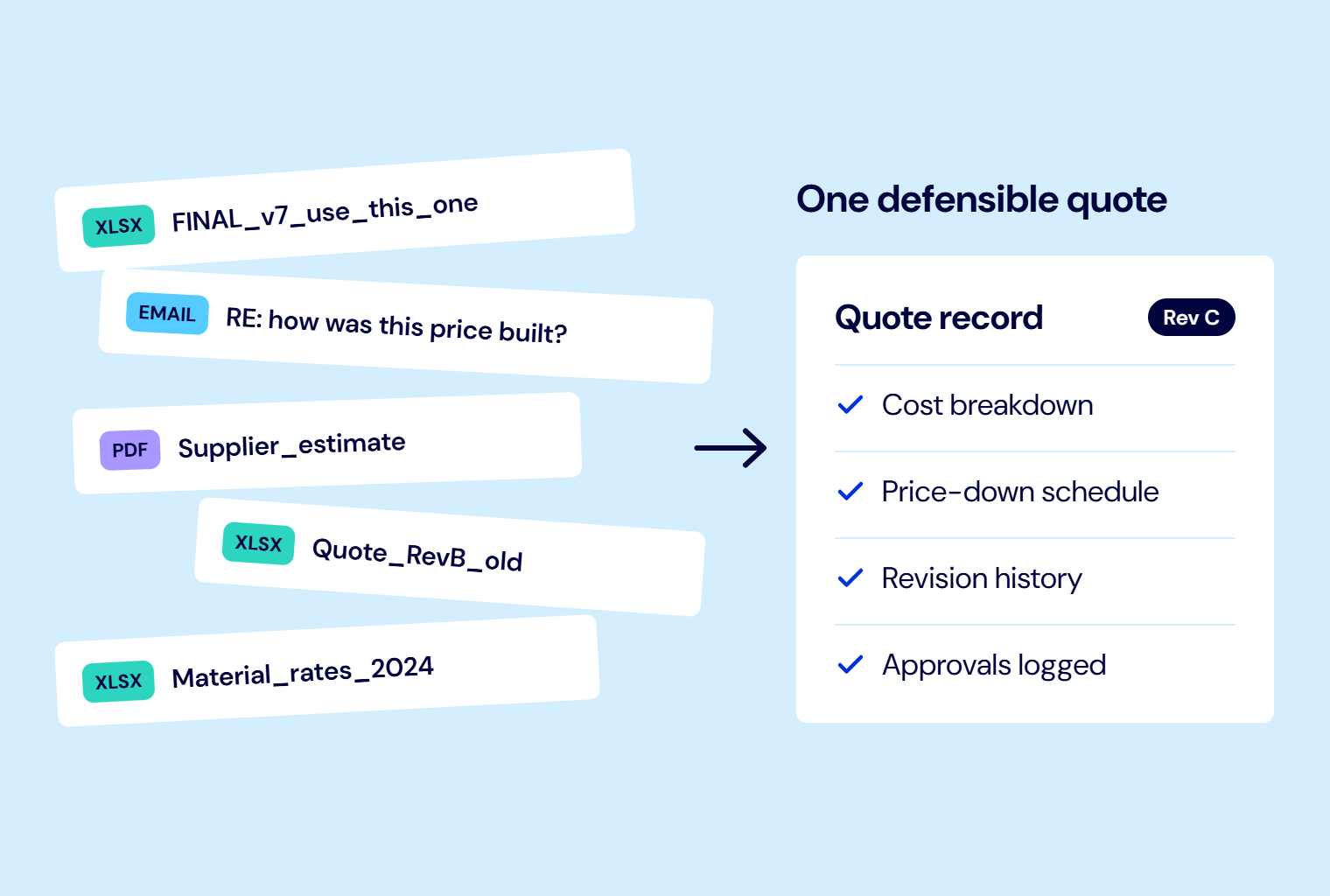
Automotive suppliers should look for three things: a cost breakdown that lives inside the quote, pricing that follows the shape of the program, and a record of every revision. Together, these separate real automotive CPQ from a pricing calculator.
A quick word on demos first. Almost every quoting tool looks great on a clean sample part. The real test is a part with a messy BOM, five years of volume, and three rounds of engineering changes, so bring one of yours.
A cost breakdown inside the quote.
Material, labor, overhead, freight, and tooling should each be visible and traceable, not collapsed into one field before anyone sees how they were combined.
Pricing that follows the shape of the program.
Automotive quotes span years of production with volume-based step-downs built in from the start. The software should model that directly instead of approximating it with a single number per year.
A record of every revision.
Not a version number, but an actual account of what changed, when, and against what cost assumptions, so a quote from three years ago can still be reconstructed today.
Evaluation checklist
| Criteria | Question to ask the vendor | Red flag |
|---|---|---|
| Cost breakdown inside the quote | Can I see material, labor, overhead, freight, and tooling for every line, inside the quote itself? | "The breakdown lives in an attached workbook." |
| Program-shaped pricing | Can the quote model five or more years of volume with annual price-downs? | "Enter one price per year and we'll calculate the rest in Excel." |
| Revision record | Can I see who changed a quote, when, and which cost assumptions changed with it? | Revisions are saved as new files. |
| Current cost data | Are material costs tied to index data, or typed in at quote time? | Material prices are entered by hand. |
| Connection to the RFQ and award | Do program and volume details flow in from the opportunity and out to program management? | Quoting is a separate tool connected by export and import. |
What is the actually cost of an innacurate quote for automotive suppliers?
A quote that can't be defended costs margin in two places: revenue that was never really there, and cost increases that can't be recovered. Both are easy to calculate.
1. Revenue overstated by a flat price
Take a part quoted at $20.00 with 300,000 units a year and a 2% annual price-down over five years.
| Year | Piece price | Annual revenue |
|---|---|---|
| 1 | $20.00 | $6,000,000 |
| 2 | $19.60 | $5,880,000 |
| 3 | $19.21 | $5,762,400 |
| 4 | $18.82 | $5,647,152 |
| 5 | $18.45 | $5,534,209 |
| Total | $28,823,761 |
If the quote approximates the program at a flat $20.00, it assumes $30,000,000 in revenue.
Revenue overstatement = Flat-price revenue − Program-shaped revenue Example: $30,000,000 − $28,823,761 = $1,176,239
That is about $1.2M of revenue the business plan counted on that the contract never promised.
2. Cost increases you can't recover
Now say material cost rises $0.60 per part in year two. If the quote documented its material assumption and the contract has an index clause, that increase can be recovered. If the assumption only lived in someone's spreadsheet, it usually comes out of margin.
Unrecovered cost (per year) = Cost increase per part × Annual volume Example: $0.60 × 300,000 = $180,000 per year
Over years two through five, that is $720,000, or about 3 margin points at the year-two price ($0.60 ÷ $19.60). See how suppliers recover missed margin from price changes and where margin leaks between quote and SOP.
What are top cost, price, quote software options for complex programs?
The top options for complex programs fall into four groups: purpose-built automotive commercial platforms, enterprise product cost management tools, CAD-based should-cost tools, and general-purpose CPQ. Each is strong at a different job, so the right fit depends on whether your hardest problem is costing a part, configuring a product, or managing a multi-year program from quote through award.
| Type | Best for | Watch for |
|---|---|---|
| Purpose-built automotive platform | Detailed part costing and multi-year program quotes in one place, with a full audit trail | Built for automotive, not simple catalog pricing |
| Product cost management | Engineering-led part costing tied to PLM data | Often stops at cost, with pricing and contract terms handled elsewhere |
| CAD-based should-cost | Early cost estimates from 3D models | Needs clean CAD and doesn't hold contract terms |
| General-purpose CPQ | Catalog pricing and quote documents | Cost models end up in side spreadsheets |
| ERP and spreadsheets | Actual cost (ERP) and flexibility (spreadsheets) | ERP doesn't hold the quoted baseline, and spreadsheets depend on who built them |
Many suppliers end up combining tools, for example an engineering cost tool for early design estimates and a commercial platform for the quote, contract, and program. The question to ask is where the quote of record lives, and whether it can still be reconstructed in year four.
What are leading AI quotation management platforms for automotive manufacturers?

Leading AI quotation platforms use AI in a few different ways: to estimate cost from part geometry, to automate RFQ intake, to help build and run configurators, or to learn from a supplier's own quote history. For automotive suppliers quoting multi-year programs, the most useful AI is the kind grounded in your own past quotes and cost assumptions, with a person approving every price.
That matters more in automotive than almost anywhere else. As Jason Versical, Vice President of Strategy and Transformation at Campfire Interactive, explains in how auto suppliers can leverage AI in commercial processes, program lives run five to seven years or more, so much of a supplier's profitability is set a year or two before the numbers ever show up in ERP. The quote is where that happens, and AI is most valuable when it helps estimators get that early decision right.
When evaluating AI in quoting, ask three questions:
-
Can it show its work? A price the AI suggests is only useful if your team can see which past quotes and assumptions it drew from. Versical makes the same point: sales, finance, and program management need to see how a number was produced and how it changed over time.
-
Does a person approve the final number? In Versical's view, AI should take on the repetitive, data-heavy work, like running dozens of pricing and volume scenarios, while the final quote decision stays with people.
-
What data is it learning from? AI trained on generic catalogs won't know your plants, rates, or OEM price-down history.
Which CPQ software should an automotive supplier choose?
Choose the tool where the quote of record can be defended years later. Fast quoting matters, but speed without a cost breakdown, program-shaped pricing, and a revision record just produces wrong answers faster. Start with the part of the process that hurts most, often costing or revisions, and look for a partner that knows automotive suppliers. Our guide to choosing sales software for automotive suppliers covers what to look for in a partner.
FAQ
Q: What is the best CPQ software for automotive suppliers?
A: The best option keeps the full cost breakdown inside the quote, models multi-year pricing with price-downs, and records every revision. Campfire Interactive's Cost, Price, & Quote is built specifically for Tier 1 and Tier 2 automotive suppliers.
Q: What is the difference between CPQ and product cost management software?
A: Product cost management tools focus on calculating what a part should cost. CPQ turns cost into a price and a quote. Automotive suppliers need both connected, so the cost behind each quote stays traceable.
Q: Can a general-purpose CPQ tool work for automotive suppliers?
A: It can, with customization. Most general-purpose CPQ tools are built for configurable products with one-time prices, so suppliers usually keep multi-year cost models, price-downs, and revision history in spreadsheets alongside them.
Q: How should AI be used in automotive quoting?
A: AI is most useful for finding comparable past quotes, running pricing and volume scenarios, and flagging cost risks. People should still approve every final price, and the AI should show which data it used.
Q: Why does a quote need a revision history?
A: OEMs, auditors, and finance teams often ask how a price was built months or years after award. A revision record shows what changed, when, and why, which is also what makes cost recovery possible.
How does Campfire Interactive handle costing, pricing, and quoting?
Campfire Interactive's Cost, Price, & Quote keeps the full cost breakdown inside the quote, using structured cost templates and a shared rate library, and shows the program's P&L across its whole life. Estimators can find comparable past quotes in seconds, run several pricing strategies side by side, and see should-cost, target-cost, and walk-away guidance for every line. When the BOM or routing changes, the cost model updates with it.
Every approval, exception, and override is logged, so a number can be reconstructed on demand, not from memory. Because Cost, Price, & Quote connects to Price Index Management, material assumptions are tied to current market data and recoverable increases are easier to claim. And because it connects to Opportunity Management, a quote inherits program and volume details directly from the RFQ, and the full cost record moves to sales and program teams at award with no re-keying.
Get in touch to see how a Campfire quote holds up when someone asks how it was built.