The Forecasting Gap in Automotive Supply Chains: Why Traditional Planning Fails — and How to Close It

The Forecasting Gap in Automotive Supply Chains: Why Traditional Planning Fails — and How to Close It

For decades, automotive suppliers have been expected to deliver precision in a world built on uncertainty. From fluctuating OEM production schedules to volatile material costs and global trade disruptions, the modern supply chain has become a test of forecasting agility. Yet despite sophisticated ERP systems and oceans of spreadsheets, most suppliers still face the same painful truth: there’s a widening gap between forecasted demand and real-world execution.

This gap isn’t just about inaccurate numbers — it’s about missed margins, stranded inventory, and lost customer confidence. The question isn’t whether forecasting is broken. It’s how suppliers can finally fix it.

The Forecasting Reality Check

Let’s start with the numbers. According to industry studies, automotive suppliers miss their demand forecasts by an average of 20–30%, even when using advanced planning systems. The result? Production inefficiencies, overtime costs, and lost profitability.

Why does this gap persist? The issue isn’t a lack of data. It’s the fragmentation of it. Each function — sales, program management, finance, and operations — is looking at a different version of the truth:

  • Sales teams build forecasts based on OEM volume projections and historical win rates.

  • Program managers plan resources based on current awarded business.

  • Finance leaders model cash flow and profitability based on both assumptions.

  • Operations executes against whatever demand signal trickles down.

By the time these perspectives reconcile — often through manual data wrangling in Excel — the market has already shifted.

This lag between insight and action defines the “forecasting gap,” and in an industry where margins are measured in tenths of a percent, it’s a silent profit killer.

The Cost of Misalignment

When forecasting misses the mark, the consequences ripple across the enterprise:

  1. Overproduction and excess inventory: A 10% demand overestimation can tie up millions in working capital that sits idle on warehouse floors.

  2. Underproduction and missed shipments: A 10% underestimation can mean line stoppages at OEM plants — and damaged supplier scorecards.

  3. Pricing and quoting inaccuracies: Without visibility into true cost and capacity scenarios, quoting teams often misprice programs, eroding margins before production even begins.

  4. Lost customer confidence: OEMs expect proactive communication and dependable capacity. Forecasting blind spots erode trust — and future business.

Put simply, the forecasting gap isn’t a planning issue. It’s a profitability issue.

Why Traditional Tools Fall Short

ERP systems were designed for transactions, not intelligence. They manage today’s orders — not tomorrow’s opportunities. Meanwhile, spreadsheets remain the default tool for flexibility, but lack the integration, governance, and real-time insight required for modern forecasting.

Most forecasting workflows in the supply chain follow a similar pattern:

  1. Sales submits a top-down projection by OEM and platform.

  2. Finance reviews, adjusts, and applies profitability targets.

  3. Program management tries to align timing, capacity, and cost structures.

  4. Operations gets a static plan — often obsolete by the next OEM schedule update.

The result: reactive firefighting, not proactive profitability management.

Closing the Forecasting Gap with Profitability A.I.

At Campfire Interactive, we believe forecasting shouldn’t just predict demand — it should guide profitability decisions across the business.

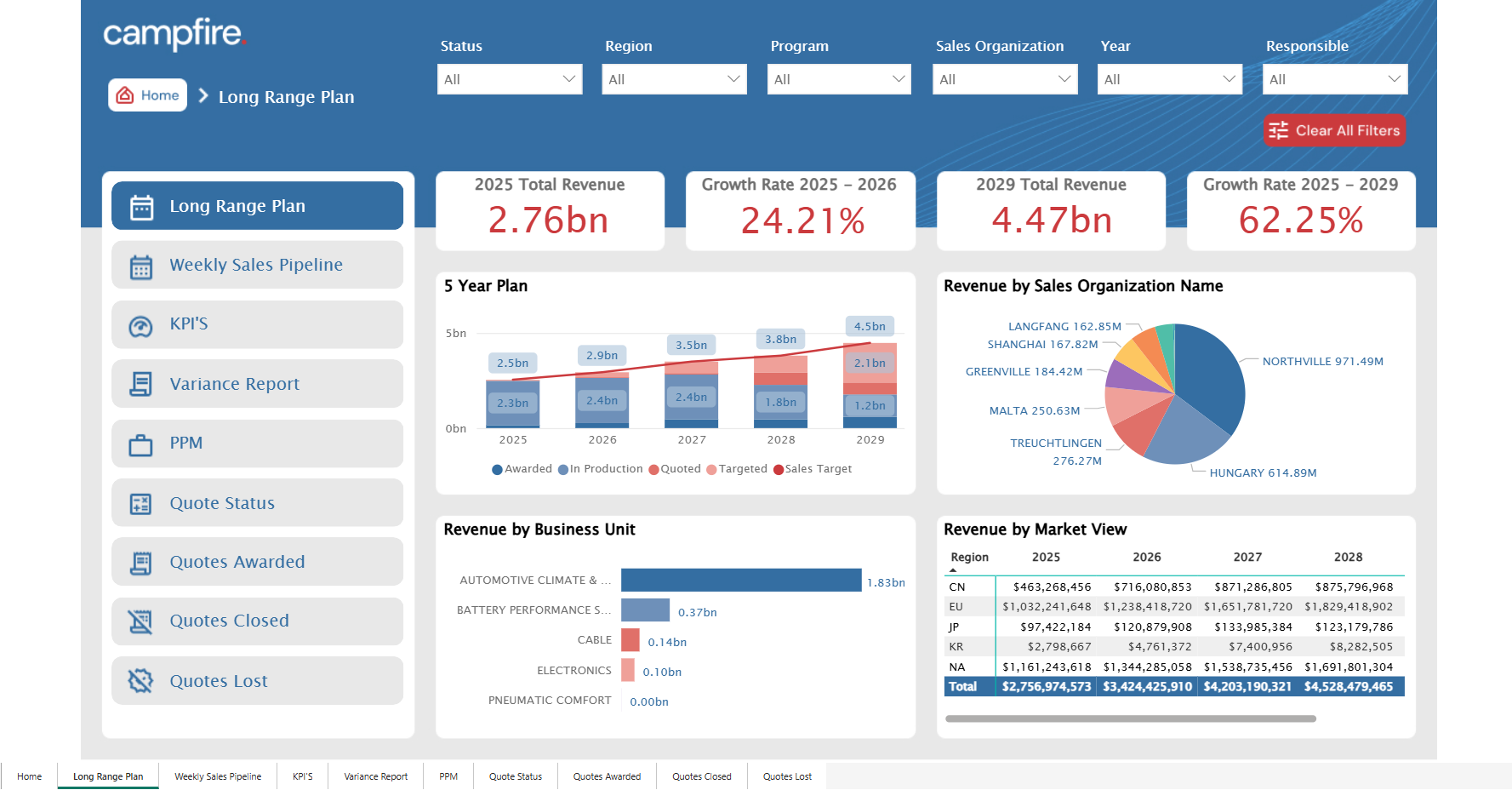
Our Opportunity and Forecast Management module, part of Campfire’s Profitability A.I. platform, bridges the gap between top-line forecasts and bottom-line results by unifying data, logic, and accountability across every stakeholder. Here’s how it works:

1. Unified Forecast Visibility

Campfire connects sales, finance, program management, and operations around a single source of truth. Every opportunity — from early-stage quotes to awarded programs — is tracked in one system, with cost, volume, and timing data integrated in real time.

Instead of debating whose spreadsheet is right, teams can see exactly how a forecast evolves and what it means for revenue, margin, and capacity.

2. Scenario Planning with Profit Intelligence

Forecasting is not just about volume — it’s about impact. Campfire enables suppliers to simulate what-if scenarios across demand changes, material costs, or production capacity.

Executives can answer questions like:

  • What happens to profit if OEM X delays a launch by 90 days?

  • How do raw material shifts impact margin across all active programs?

  • Which programs should we prioritize to protect EBITDA?

This level of foresight turns forecasting into a strategic margin management tool, not just a reporting exercise.

3. Real-Time Synchronization with OEM Signals

Campfire’s platform ingests updates from OEM forecasts, quote activity, and production schedules — allowing suppliers to adjust instantly rather than waiting for month-end reviews.

This continuous synchronization reduces the lag between OEM demand and supplier response, helping teams proactively rebalance workloads and reprice at-risk programs.

4. Profitability Forecasting at the Portfolio Level

Traditional systems forecast revenue; Campfire forecasts profitability.
By layering cost drivers, timing, and program risk factors into each opportunity, suppliers gain a complete picture of their future profit trajectory — across plants, OEMs, and vehicle platforms.

The outcome: better decisions, faster quotes, and more predictable margins.

From Forecast Accuracy to Profit Accuracy

Many suppliers focus on improving forecast accuracy — but that’s only part of the story. What truly matters is profit accuracy: knowing which programs, customers, and materials will drive or drain future profitability.

By closing the forecasting gap, Campfire enables suppliers to:

  • Quote faster and smarter, backed by unified cost and demand intelligence.

  • Align finance and operations on the same margin-focused forecast.

  • Reduce surprises, improving predictability and OEM trust.

  • Reinvest profits strategically, guided by portfolio-level visibility.

It’s not just about knowing what will happen — it’s about shaping what should happen.

The Future of Forecasting in the Automotive Supply Chain

The automotive supply chain is entering a new era defined by electrification, platform consolidation, and just-in-time risk recalibration. The suppliers who thrive will be those who can predict profit with precision — not just manage chaos.

Closing the forecasting gap is the first step. But staying ahead means embracing systems that learn, adapt, and anticipate — where every opportunity, quote, and forecast connects to a unified view of profitability.

That’s what Campfire’s Profitability A.I. delivers: a smarter way to forecast, a faster way to quote, and a clearer path to profitable growth.

Related Posts